
Planning to Succeed
How coaches created another way to score points.

Just when defence coaches thought it was safe to come out from behind the sofa, attack coaches have realised they can create more opportunities for success when receiving goaline and 22m drop-outs. It turns out, as more teams take to preparing set attacks from these opportunities, they’ve just got better and better.
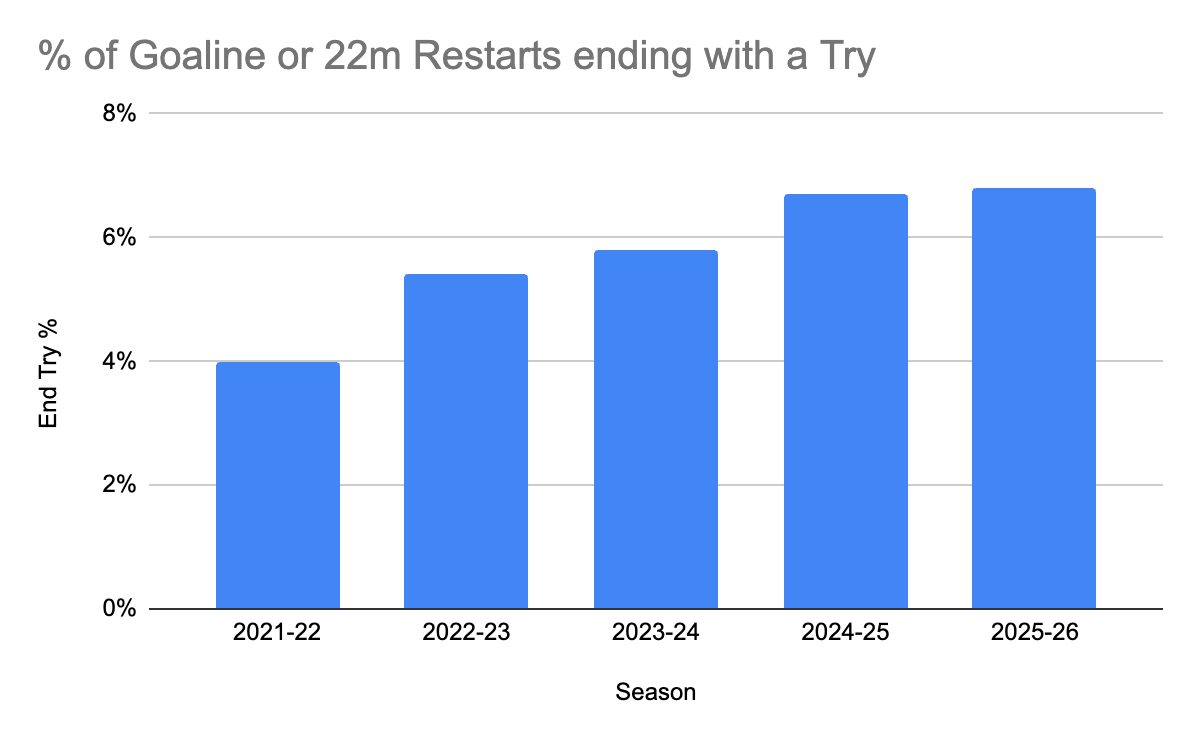
Using Oval-Insights data, we can see that the % of these possession starts which have ended in a try have increased from 4% in 2021-22 to 6.8% so far this year - that is an increase of 70%. Whichever way you slice it, teams are finding ways to get more from possessions which begin from restarts. But how?
Over the last two seasons, the best team by this metric are Ulster who have scored on a remarkable 26.3% of restart possessions. Their approach is very similar to the revolutionary one Ireland took a few years ago when they really popularised planning for restarts, at least in the Northern Hemisphere. They start with a strong carry, league style, where they aim to go infield and create a blindside and a hefty openside. In this case, they rush players to the openside then rush others in the opposite direction and that misdirection creates the linebreak. Of course, once the break has happened then it becomes unstructured and you can’t plot your way to the line for an attack of this length.
This is one of the interesting elements of tries scored from restarts; 53% of them come after three phases. In general, just 34% of tries come after three phases. My theory for this is that the planning element of restart tries allows you to gain early momentum but because you start a long way from the line, you need to keep sustained pressure to score.
Colomiers are second in the list with 21.4% of restart possessions ending in a try. They lead with nine tries scored from these possessions. However, of those nine tries just two came from three phases and three came from ten phases or more. There is a 44% increase in carries per possession from goal line or 22m restarts than in general possessions. Colomiers don’t necessarily have a clear set of planned moves fromm their restarts but they just maintain possession and eventually work their way to tries.
We see a lot of breaks like these from restarts. Here the attackers look to target the edges of the rucks with intricate attacks which target both sides. I have a theory as to why this is common.
When starting a restart possession you don’t actually know where the ball will be. Attackers try to run to the 15m lines as we have seen to create a consistent starting point but it’s not like a lineout where you know, as long as you win the ball, exactly where everyone will start from. If you don’t know where everyone will be then the easiest thing to do is attack a consistent point, in this case the edges of the ruck. Because it is a set play then you can make sure you get people where they need to be after the first carry. Plus, all the movement of people around the pitch helps to hide something like this.
Conclusion
It is interesting how I began this article believing that the increase in tries from restarts was caused by more planning in the initial phases. That is certainly a part of it, but when we look in more depth at the numbers we can see that tries actually come more commonly from sustained phases rather than in the initial few phases. What appears to be happening is teams are planning the first few phases and that gets them into the 22 and then they begin a second attack in the 22 where they just maintain possession. Most importantly though, this is becoming yet another major battleground for rugby.

Pre-Order Link - https://geni.us/AttackingTheSpace
Interesting read Sam! If you’ve got a moment please check out my stuff!